
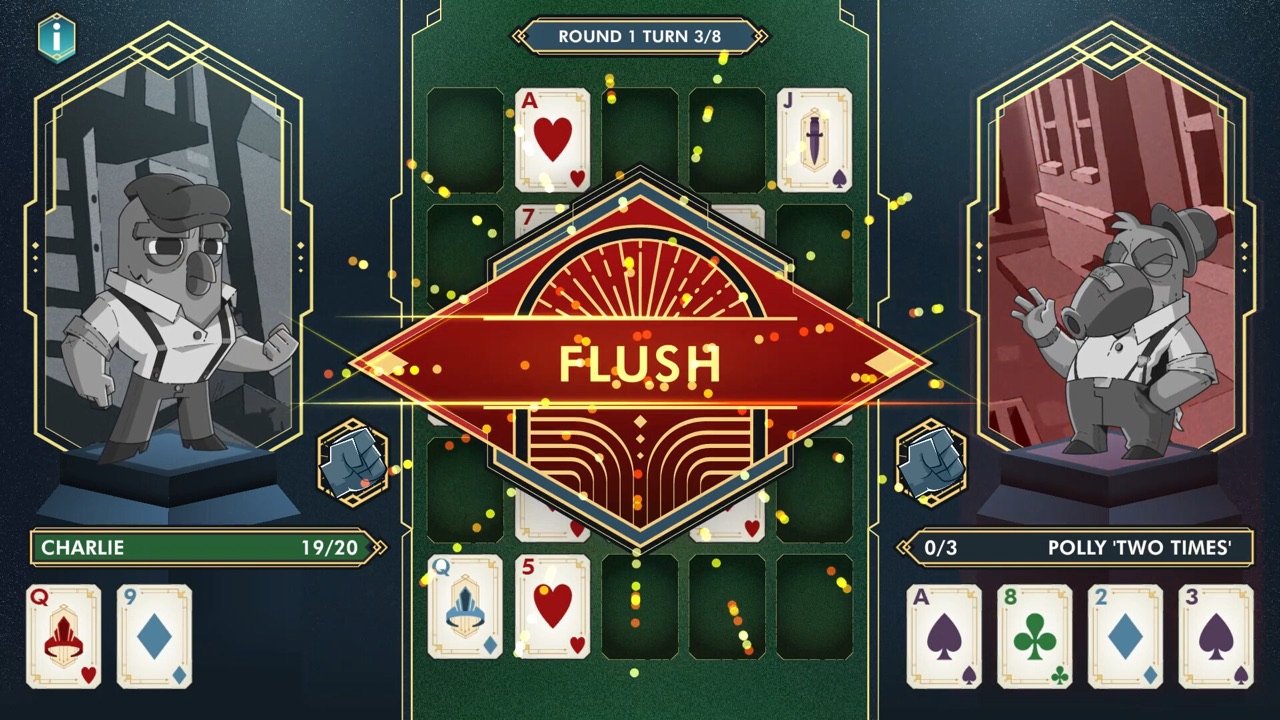
The 5-by-5 Board
The board is a square grid of five rows and five columns. The developer's browser Demo instructions, updated in May 2026, describe it, and an independent Steam player review of the Demo confirms the same format. Every fight takes place on this grid.
Each turn you place two cards. A line is complete when it holds five cards. Because cards sit in rows, columns and sometimes diagonals, one placement can count toward several lines.
Which Lines Count
Three kinds of lines are scored. A row runs across the board, a column runs down it and a diagonal runs corner to corner. Any of them forms a poker hand once all five cells are filled.
- Rows — five horizontal lines.
- Columns — five vertical lines.
- Diagonals — the two corner-to-corner lines.
Hand Types Named in the Tutorial
The tutorial names pairs, straights and flushes. A pair is two cards of the same rank, a straight is five cards in sequence and a flush is five cards of the same suit. These are standard poker terms, and the game uses them to label lines.
Official screenshots also show banners such as “Flush” and “Two Pair” during fights, and a weapon screen with a hand-ranking table. Use the in-game hand reference for the full list in your version. A Demo player review specifically mentions that this reference is easy to reach.
How Hands Turn Into Attacks
Completing a hand causes an attack. The instructions state that stronger hands increase attack strength. That is the core of combat: build better lines to hit harder.
Depending on your setup, hands can support damage, armor, healing or control. Your equipment can change what a hand does. Check the combat feedback after each line to see the effect in your build.
Planning Your Placements
Good play starts with reading the board before each pair of cards. Look for lines that are three or four cards long. Then decide whether to finish a line now or set up a stronger hand for later.
- Prefer cells that advance two lines at once.
- Count how many cards each line still needs.
- Avoid filling a line with a weak hand when a stronger one is close.
- Use tricks such as suit changes to complete flushes.
Tricks and Equipment That Affect Hands
Tricks can change a card's suit, which can turn an almost-flush into a flush. Trinkets and weapons add their own effects to combat. In the earlier Demo, relics were triggered by suits, though they were rebuilt in the September 2026 test.
Learn the hand rules first, then layer equipment on top. Equipment changes what a hand does, but not which lines count. Our tricks, weapons and relics pages describe what is confirmed for each.
Rules That Are Not Confirmed
The sources do not give a full damage table for each hand. Tie rules, whether an Ace can count low in a straight and how bonuses stack are also undocumented. Standard poker knowledge cannot prove those game-specific rules.
Do not confuse casino cash payouts with combat damage either. The game uses poker hands for fighting, not for betting returns. If a placement seems invalid, check the in-game reference before assuming it is a bug.
Why the Version Matters
These rules come from the browser Demo instructions and an earlier Demo review. The developer published a poker design devlog on June 25, 2026, and changed several systems in a September playtest. Some details may differ in the Early Access build.
Always read the current in-game reference before relying on an older rule. We will update this page once the Early Access version can be checked. Start with the beginner guide if you are new.
A Quick Example Turn
Imagine a row that already holds four cards, three of them hearts. You place two cards this turn, so you can finish that row and still use your second card elsewhere. If the last card is a heart and the other cards are hearts too, the row becomes a flush.
Your second card might go into a column that is three cards long. That sets up a later hand without wasting the turn. This kind of two-step planning is what the grid rewards, though the exact attack values depend on your version.
Hands Seen in Official Screenshots
Official Steam screenshots show several moments from fights. One shows a large Flush banner across the grid, another a Two Pair banner. A third shows a line of cards glowing during an attack.
A separate screenshot shows a weapon screen with a hand-ranking table that starts from one pair. These images confirm how hands are presented in the builds shown. They do not provide current damage numbers.
Learning Faster With the Demo
The free Demo on Steam is the easiest place to practise the grid. It includes a tutorial and two casino floors. A Demo player review notes that the hand reference is easy to reach.
Play a few fights focusing only on completing lines, without worrying about equipment. Once finishing hands feels natural, start choosing weapons and trinkets that reward your favourite hands. The beginner guide covers how to start.
Common Placement Mistakes
New players often finish a line as soon as they can. That can lock in a weak hand when a stronger one was one card away. Waiting a turn is sometimes better.
Another mistake is ignoring diagonals. They are easy to forget but count just like rows and columns. Check both diagonals before every placement.
Frequently Asked Questions
How many cards do you place per turn?
Two. The documented browser Demo rules describe placing two cards per turn on the 5-by-5 grid.
How do poker hands work in The Golden Caravan?
You place two cards per turn on a 5-by-5 grid. A completed five-card row, column or diagonal is scored as a poker hand and causes an attack.
Do better hands do more damage?
Yes. The Demo instructions state that stronger hands increase attack strength. An exact damage table has not been published.
Which hands are in the game?
The tutorial names pairs, straights and flushes, and official screenshots show Flush and Two Pair banners. Use the in-game hand reference for the full list in your version.
Can an Ace count low?
This has not been documented. Check the in-game hand reference rather than relying on standard poker rules.
Official Trailer
Sources and Further Reading
- Bigfoot Games — browser Demo instructions on Kongregate (May 2026 update)
- Arcurath — firsthand Steam Demo review
- Bigfoot Gaming — The Golden Caravan on itch.io
- Bigfoot Gaming — poker design devlog (Steam, June 25, 2026)