
Tricks vs Trinkets
The two systems are easy to mix up because of their names. Tricks are active: you choose when to use them to change the card situation. Trinkets are passive run modifiers that come from slot machines and work in the background.
Knowing the difference shapes how you plan. A trinket rewards a condition whenever it happens. A trick lets you create or fix a condition at a moment you choose. See the trinkets page for the passive side.
What Is Confirmed About Tricks
Changing a card's suit is the best-documented trick effect. The developer described it in a July 23, 2026 post about the PC, Mac and web playtest. A separate July 3, 2026 developer post also described changing suits during a turn.
An independent Steam review of the earlier Demo adds that tricks can modify a card. That gives us three sources agreeing on the core idea. Beyond suit changes, other example abilities were described by the developer but not independently tested.
Why Suit Changes Matter
Poker hands on the 5-by-5 grid come from five-card rows, columns and diagonals. Flushes depend on suits, and the tutorial names flushes as one of the hand types. Changing one card's suit can turn a nearly complete line into a finished hand.
Suit-based effects also appear elsewhere. In the earlier Demo, relics were suit-triggered passives. A trick that fixes a suit can therefore support more than one part of a build, though current relic rules have changed.
How to Get Tricks
Access to tricks depends on the version you are playing. The September 9, 2026 playtest announcement introduced a mid-run Trickster offer as a new opportunity. That test ran until September 16, 2026.
Treat the Trickster as a dated change, not a guaranteed encounter in every build. Earlier versions may have offered tricks differently. Check the in-game shops and offers in the version you have installed.
Reading a Trick's Tooltip
Because no complete catalog exists, the tooltip is your main source. Read what the trick changes, when you can use it and whether it has limits. Then think about which of your lines it can help finish.
- What it changes: suit, card or position.
- When it can be used during a turn.
- Any cost, charge or limit shown in the tooltip.
- Which hand type it helps you complete.
Using Tricks Well
A trick is most valuable when one change completes a hand that was otherwise out of reach. Look for lines that are four cards long and need only one fix. Using a trick on a line that is far from complete usually wastes it.
Tricks also pair naturally with builds that reward a specific hand. If your equipment favors flushes, a suit change directly supports your plan. Our best builds page explains how to judge those combinations without a tier list.
What Is Still Unknown
No complete list of current tricks has been verified. Charge limits, prices, cooldowns and unlock order are also unconfirmed. We will not present the developer's illustrative examples as a full inventory.
We will add a catalog once current tooltips from the Early Access version can be checked. Each entry will carry its version. Until then, rely on the in-game descriptions.
Tricks Across the Development Timeline
Tricks have been described at several points in development. An earlier Steam Demo review reports that tricks can modify a card. In July 2026, two developer posts described changing suits during a turn.
The September 9, 2026 playtest then added the mid-run Trickster offer. Each of these sources describes a slightly different stage of the game. Keep their dates in mind when you compare advice.
What the Official Screenshots Show
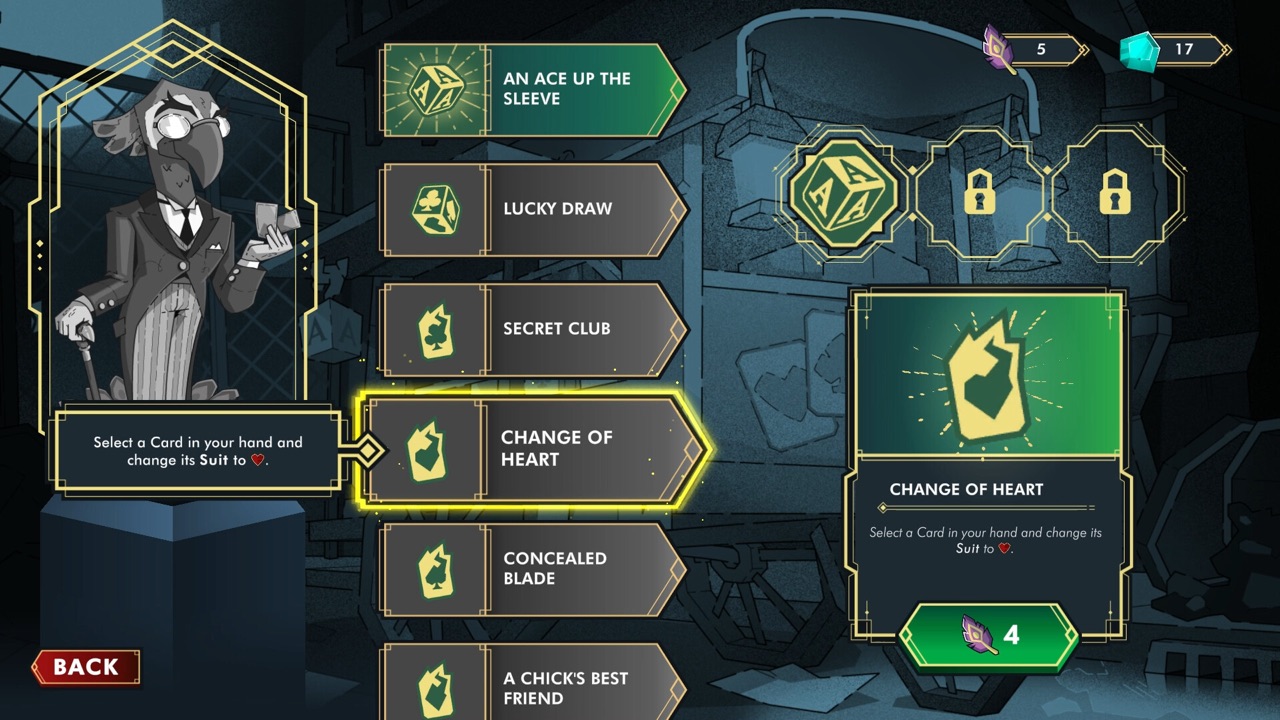
One official Steam screenshot shows a menu of named card abilities. The ability selected in that image is called Change of Heart, and its panel reads: select a card in your hand and change its suit to hearts. The same menu also lists entries such as An Ace Up the Sleeve, Lucky Draw, Secret Club, Concealed Blade and A Chick's Best Friend.
The screenshot confirms that a menu of named abilities existed in the build shown. It does not confirm their current effects, costs or unlock rules. Read the tooltips in your own version for those details.
Tricks and the Card Grid
Every hand comes from a five-card row, column or diagonal on the 5-by-5 grid. A trick that changes one card can affect every line that card belongs to. That makes placement and timing just as important as the trick itself.
Before using a trick, check all the lines that pass through the card you plan to change. Sometimes one change completes two hands at once. Our poker hands page explains the grid rules.
Common Mistakes With Tricks
The most common mistake is using a trick too early. A suit change on a line that is far from complete rarely pays off. Save tricks for lines that need only one fix.
Another mistake is assuming old trick lists still apply. Trick access changed in the September 2026 playtest. Check the tricks offered in your version.
Frequently Asked Questions
Can a trick change a card's suit?
Yes. Changing a card's suit is the best-documented trick effect, described in two July 2026 developer posts and supported by a Demo player review.
What do tricks do in The Golden Caravan?
Tricks are active card manipulation. The best-documented example is changing a card's suit, described by the developer and corroborated by a Demo player review.
Are tricks the same as trinkets?
No. Tricks are active abilities you choose when to use. Trinkets are passive run modifiers that come from slot machines.
Where do you get tricks?
It depends on the version. The September 2026 playtest added a mid-run Trickster offer, but that is a dated change and may not appear in every build.
Is there a full list of tricks?
No complete current list has been verified. Read each trick's tooltip in game for its exact effect and limits.
Official Trailer
Sources and Further Reading
- Developer post — PC / Mac / Web playtest (r/playmygame, July 23, 2026)
- Developer post — card manipulation explained (r/Appstore, July 3, 2026)
- Arcurath — firsthand Steam Demo review
- Bigfoot Gaming — “Playtests Start NOW!” (Steam announcement, September 9, 2026)